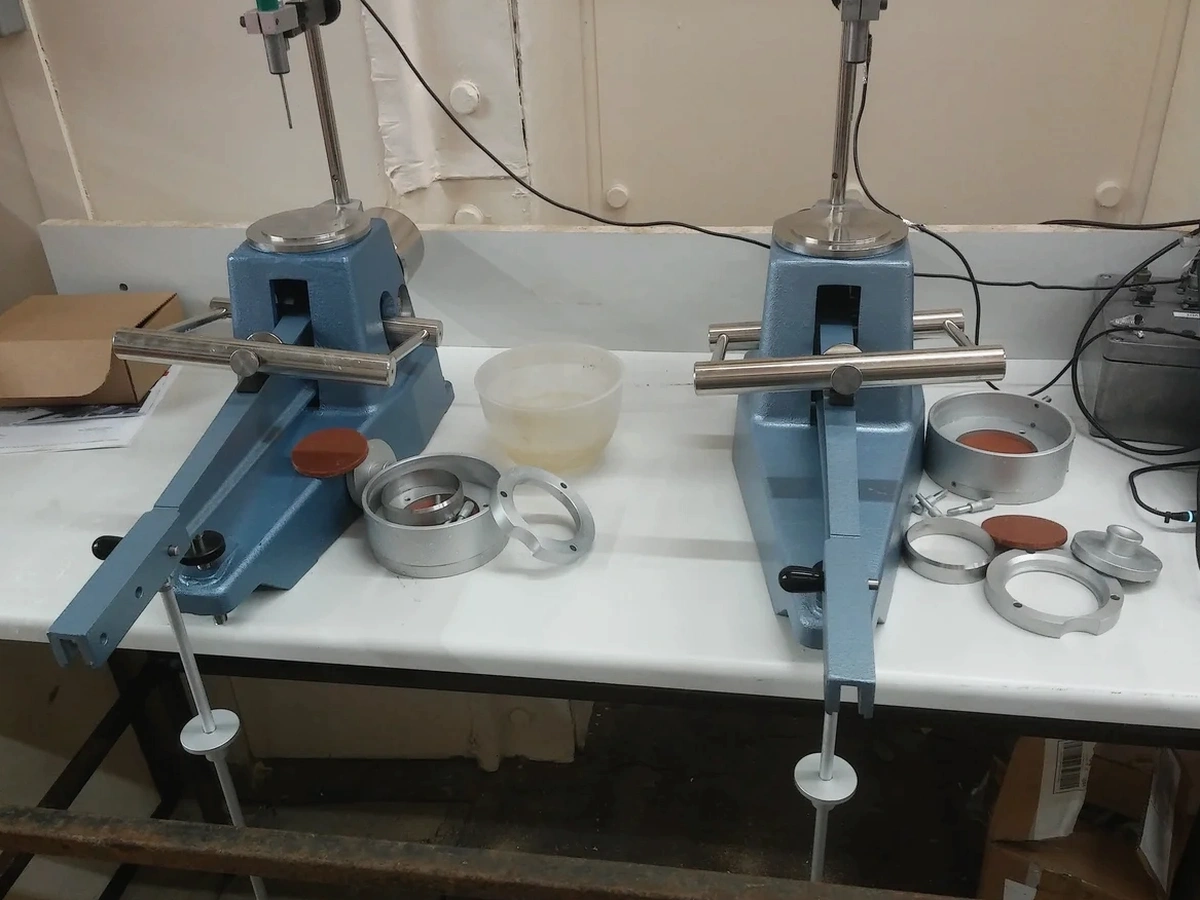
In Peoria, the transition from weathered loess to dense glacial till can happen within a few vertical feet. When we run Atterberg limits on these soils, the plasticity index often jumps from 8 to 22 across a single Shelby tube sample. That shift changes everything for foundation bearing capacity and shrink-swell risk. Our lab processes the liquid limit and plastic limit per ASTM D4318. We combine the results with a grain size analysis when silty clay layers show borderline classification between CL and ML. For sites near the Illinois River bluffs, we also correlate the plasticity data with slope stability assessments, because a PI above 20 in saturated loess signals potential for shallow rotational failure.
A plasticity index above 25 in Peoria's loess means you need to account for at least 2 inches of swell potential under a slab-on-grade.
Relevant standards
ASTM D4318-17e1 — Standard Test Methods for Liquid Limit, Plastic Limit, and Plasticity Index of Soils, ASTM D427-04 — Test Method for Shrinkage Factors of Soils by the Mercury Method, ASTM D2487-17 — Standard Practice for Classification of Soils for Engineering Purposes (Unified Soil Classification System), IBC 2021 Section 1803.5.3 — Expansive Soils Investigation and Classification
Quick answers
How much does Atterberg limits testing cost in Peoria?
The liquid limit and plastic limit determination on a single sample runs between US$50 and US$100. A full set including shrinkage limit and hydrometer for USCS classification typically falls in the US$75 to US$120 range per sample. Rush turnaround adds a small surcharge.
How many Atterberg samples do I need for a building permit in Peoria?
The IBC requires at least one Atterberg test per distinct soil stratum encountered. In Peoria's layered loess-over-till profile, budget for a minimum of two samples per boring: one in the upper loess and one in the underlying glacial till. Large projects with variable geology may need more.
What is the difference between liquid limit and plastic limit?
Liquid limit is the moisture content at which soil transitions from plastic to liquid behavior. We measure it using the Casagrande cup device at 25 blows per ASTM D4318. Plastic limit is the moisture content where the soil stops behaving plastically and starts crumbling. It is determined by rolling threads to 3.2 mm diameter. The difference between the two is the plasticity index.
Can Atterberg limits predict foundation problems?
Yes. A plasticity index above 25 in Peoria's clays indicates high swell-shrink potential, which can heave slabs and crack basement walls. A liquidity index near or above 1.0 means the soil is soft and will yield under footing loads. Atterberg limits combined with in-situ moisture content give us the data to design foundations that account for these behaviors.