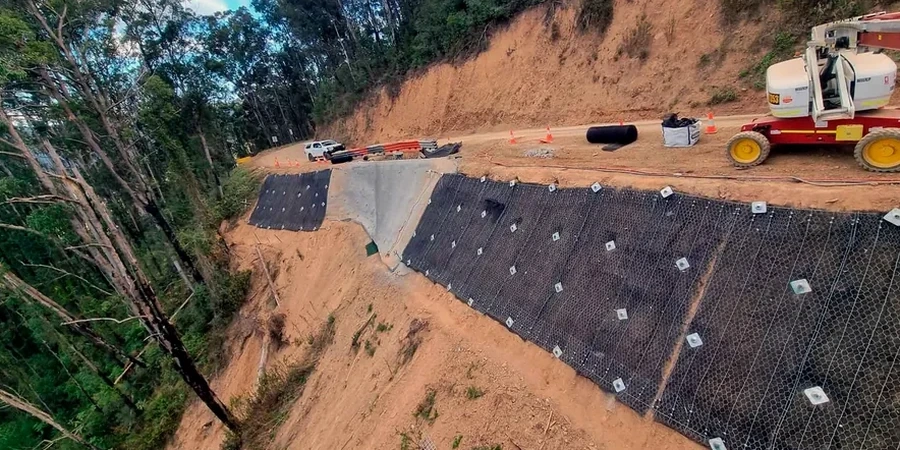
The soil conditions on Peoria's bluffs bear little resemblance to the broad floodplain along the Illinois River. Up on the heights near Grandview Drive, you might hit stiff glacial till and a thick loess mantle that stands nearly vertical when dry. Down by the riverfront, the same bluff line is undercut by saturated, layered silts that have been creeping for decades. When a project straddles these two worlds—or begins excavating anywhere near a slope—the assumptions made at the desk can cost real money in the field. That is why a site-specific slope stability analysis matters here. We combine local drilling data with the laboratory strength testing necessary to model how these collapsible loess soils behave under load, and we cross-check the results with in-situ test pits when access allows, giving you a model that reflects the real stratigraphy, not just a textbook case.
Peoria's loess can lose over half its apparent cohesion upon saturation—a fact that turns a safe cut into a maintenance headache within one rain season.
Our approach and scope
The governing framework for our work in Peoria draws from the IBC Chapter 18 provisions and ASCE 7 load combinations, but the real backbone is the site-specific shear strength envelope we develop for each stratum. Illinois loess is notorious for losing cohesion when it wets, which means a slope that looked stable in August can become a liability after a wet October. Our analysis defines the factor of safety under both static and pseudo-static conditions, modeling the perched water tables that form on the Pleistocene till contact. The output is not just a number; it is a clear recommendation on setback distances, drainage control, and whether flattening the slope or installing a structural system makes financial sense. For projects where the bedrock is deeper than anticipated, we often run parallel scenarios so the owner can see the cost difference between a simple regrade and a more involved solution like a reinforced slope or a soldier pile wall.
Local geotechnical context
The Illinois State Geological Survey maps much of the Peoria West quadrangle as having a high potential for slope instability, particularly where the Glasford Formation meets the overlying Roxana Silt. Deep-seated failures are rare here; the real threat is shallow translational sliding within the top ten to fifteen feet, triggered when stormwater infiltrates through old desiccation cracks or poorly compacted fill. A site on the bluffs might look flat on a plat map but contain twenty feet of relief over a hundred-foot run. Ignoring that gradient during the planning phase leads to surficial slumps that undermine footings, crack pavements, and clog downslope drains. We quantify this risk using back-analysis of local failures, calibrating our models to the strength values that actually caused movement, not just the ones that looked conservative in the lab.
Quick answers
How much does a slope stability analysis cost for a typical Peoria residential lot?
For a single-family lot on a moderate bluff slope in Peoria, the combined investigation and analysis typically ranges from US$1,090 to US$4,070. The final cost depends on access for drilling equipment, the number of borings required, and whether groundwater monitoring wells are needed.
What triggers the need for a slope stability study under the Peoria building code?
The IBC triggers a study when you are building on a slope steeper than 1:3 (vertical to horizontal) or when a proposed cut exceeds five feet in height. In Peoria, the building department also looks closely at sites within 200 feet of a mapped ravine or the Illinois River bluff line, even if the slope appears gentle on the surface.
How long does the analysis take once the borings are complete?
Laboratory shear testing on Shelby tube samples takes about two weeks. The computational modeling and report writing add another week. You should plan on three to four weeks from the day the drill rig leaves the site until you have the stamped report in hand.
Can you recommend a stabilization method without a full analysis?
No, and any contractor who offers a one-size-fits-all solution for a Peoria bluff should be questioned. The interaction between the loess, the underlying till, and the seasonal perched water table is too site-specific. A failure from an underdesigned fix often costs three times more to repair than doing the analysis properly the first time.