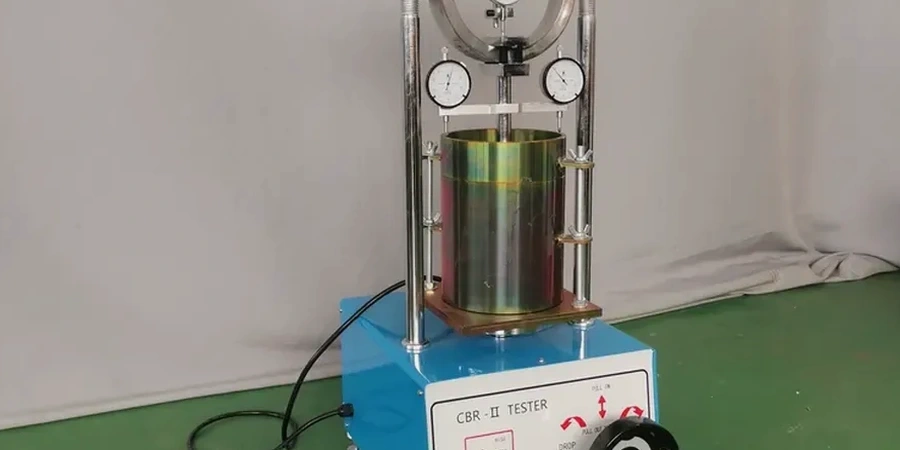
Our Peoria testing bench centers on a motorized loading frame equipped with a calibrated 50 kN load cell and a 1.27 mm/min constant-rate-of-penetration actuator. The assembly mounts a 49.6 mm diameter piston that pushes into a 152.4 mm diameter mold, prepared with Peoria County’s silty clay or IDOT CA-6 aggregate, compacted to target density under a 4.54 kg rammer. Displacement transducers log penetration at 0.025-inch intervals while the load ring captures resistance. Because Peoria sits on the Illinois River bluffs, where loess and glacial till intermix, we run both soaked and unsoaked sequences: specimens submerge for 96 hours in a water bath with 4.5 kg surcharge plates to simulate pavement saturation cycles. The bench includes a swell plate with a dial gauge reading to 0.001 inch, so we capture the expansion potential typical of Peoria’s fat clays before the piston ever touches the surface. This is the same equipment configuration we use when correlating results with field CBR for road construction to verify in-place conditions.
A 96-hour soaked CBR on Peoria silt loam often drops below 3 percent — without that number, a pavement section fails in three freeze-thaw cycles.
Our approach and scope
Peoria’s road network grew in bursts: the 1830s riverfront wagon trails, the 1913 concrete paving experiments on Adams Street, the 1950s interstate push that cut I-74 through the bluff, and today’s Warehouse District redevelopment. Each era left a distinct subgrade legacy. The older downtown sits on compacted fill laced with brick rubble and cinders that produce erratic CBR values between 4 and 18 percent. Newer subdivisions east of Illinois Route 6 rest on Peoria silt loam, a wind-deposited loess that loses strength dramatically when wetted. Our laboratory CBR test program accounts for this history: we mold specimens at optimum moisture per AASHTO T 180, then soak them to simulate a spring thaw when the water table rises against the Illinois River. The load-penetration curve we generate tells a contractor whether that subgrade needs lime stabilization or a thicker aggregate base, and by how many inches. No two Peoria neighborhoods behave the same, so we calibrate each test to the specific geologic unit the boring logs identify.
Local geotechnical context
A warehouse project off War Memorial Drive in Peoria taught us this lesson the hard way. The geotech report flagged 12 feet of lean clay with a liquid limit near 45, but the developer skipped the lab CBR test to save two weeks. They placed 6 inches of CA-6 aggregate over the subgrade and paved in August, when the clay was dry and stiff as shale. By February, after three months of snowmelt percolating through cracked asphalt, the subgrade had softened to a CBR below 2.5 percent. Wheel ruts appeared within weeks, and the loading dock apron had to be torn out and rebuilt with 18 inches of lime-modified subbase. The cost of that fix exceeded the original paving contract. In Peoria’s climate, where the frost depth reaches 36 inches and the Illinois River keeps groundwater high in the valley, skipping the CBR test means betting a pavement’s lifespan on a guess. We run both design CBR at target density and the soaked CBR at the expected in-service moisture, so the structural section accounts for the worst week of the year — not the best.
Quick answers
How long does a laboratory CBR test take from sampling to report?
For a standard soaked CBR on Peoria soils, allow 7 to 10 calendar days. The compaction and setup take one day, the 96-hour soak runs over four days, and the penetration test plus analysis requires one more day. Unsoaked CBR on aggregate base can be completed in 2 to 3 days.
What CBR value does IDOT require for pavement subgrade in Peoria?
IDOT typically requires a minimum soaked CBR of 6 percent for flexible pavement subgrade, but many Peoria silt loam soils fall below that threshold. When lab results come back at 3 to 5 percent, the standard remediation is lime stabilization or a thickened aggregate base designed to bridge the weaker subgrade.
What does a laboratory CBR test cost in Peoria?
A single-point soaked CBR test in our Peoria lab runs between US$120 and US$230, depending on whether it includes swell measurement and multiple compaction efforts. A three-point CBR curve for IDOT submittal costs more due to the extra specimen preparation and testing time.
Can you test aggregate base material with the CBR method?
Yes. We regularly test IDOT CA-6 and CA-10 crushed stone in our Peoria lab using unsoaked CBR per ASTM D1883. The larger aggregate particles require a 6-inch mold, and we often run the test at the moisture content expected after placement and compaction, rather than soaking.