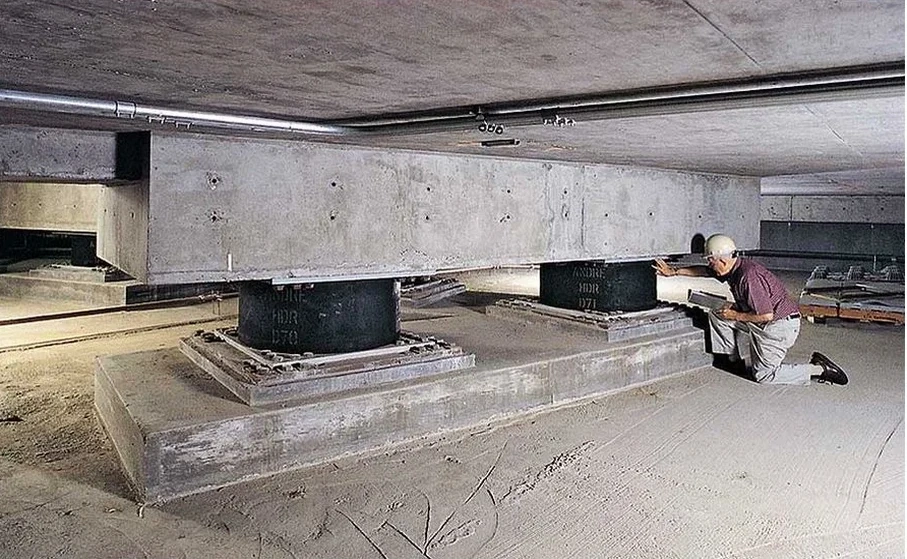
The Illinois River basin left Peoria with layered alluvial deposits — silts, clays, and loose sands that amplify seismic waves differently than the bedrock of Chicago. We see it in the lab every time a boring log comes in from the Warehouse District versus the bluffs near Grandview Drive. Base isolation seismic design lives and dies by the quality of the geotechnical input. You can specify the best elastomeric bearings on the market, but if the shear wave velocity profile is wrong, the period shift calculation means nothing. Our team runs the full suite of dynamic soil tests — resonant column, cyclic triaxial, bender elements — so the structural engineer gets real modulus degradation curves, not generic textbook values. When a hospital expansion or a downtown retrofit demands seismic microzonation data, the lab work has to be careful, because Peoria’s soil column changes within half a mile.
Peoria's alluvial silts demand site-specific modulus reduction curves — generic data from other regions won't survive a peer review.
Local geotechnical context
Peoria doesn't sit on the New Madrid fault, but it feels it. The 1811-1812 earthquakes rang church bells in Boston, and the soft soils here amplify long-period motion exactly where base-isolated structures are sensitive. The risk isn't just peak ground acceleration — it's resonance. If the isolator effective period lands near the site's natural period, amplification cancels the isolation benefit. That's why we measure Vs profiles down to 30 meters minimum, per IBC site classification requirements. A stiff till layer over soft clay creates an impedance contrast that traps energy. We've seen it in downhole seismic data from the medical district. Combine that with a high water table common along the riverfront, and you get a site class E or F that demands nonlinear time-history analysis, not just the equivalent lateral force procedure. Ignoring the basin effects here isn't conservative — it's a design flaw that shows up when the long-period waves arrive from the Wabash Valley seismic zone.
Quick answers
What lab tests are mandatory for base isolation design in Peoria?
ASCE 7 requires site-specific geotechnical investigation including shear wave velocity measurement to define site class, plus lab testing to establish modulus reduction and damping curves for the soils supporting the isolators. At minimum we run resonant column or cyclic direct simple shear, index testing (Atterberg limits, grain size distribution), and consolidation tests if the bearing stratum is fine-grained. The IBC also mandates special inspection of the isolator testing program.
How do Peoria's soil conditions affect isolator performance?
The alluvial silts and soft clays along the Illinois River valley amplify long-period ground motion — exactly the period range where base-isolated structures operate. If the site period and the isolated structure period coincide, you lose the isolation effect. Our lab measures the actual dynamic properties of the soil column so the structural engineer can detune the system and avoid resonance with the Wabash Valley or New Madrid seismic sources.
What does base isolation testing cost for a Peoria project?
A complete lab program for base isolation — including resonant column on 3-4 specimens, cyclic triaxial, index testing, and consolidation — typically ranges from US$4,040 to US$7,780 depending on the number of borings and the complexity of the soil profile. We deliver a fixed-scope proposal after reviewing the geotechnical boring logs.
How long does the lab testing program take?
Standard turnaround is 4 to 6 weeks from sample delivery. Resonant column testing is slow by nature — each specimen requires staged consolidation and multiple strain levels, and we run it until the modulus curve stabilizes. Expedited scheduling is available for hospital or emergency works projects where the construction timeline is compressed.