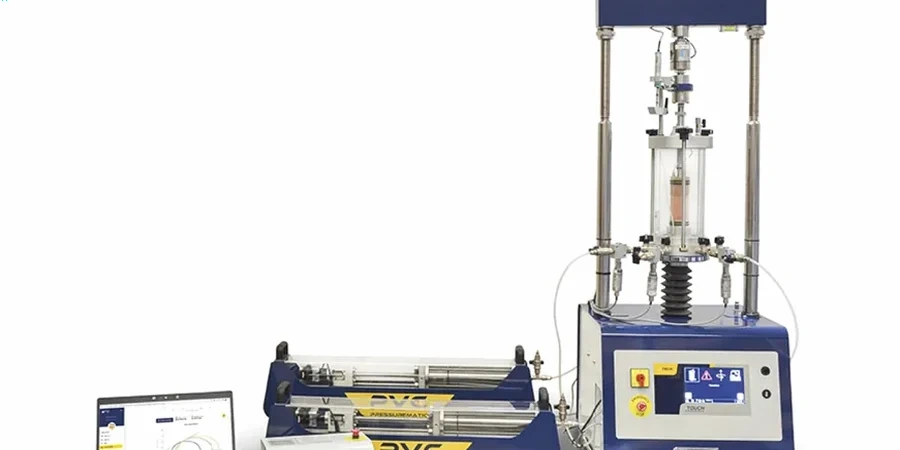
Peoria sits on a complex glacial and alluvial geology that changes fast from the bluffs down to the Illinois River floodplain. You can hit stiff loess on a blufftop site in the morning and soft silty clay by the river in the afternoon. That variability makes shear strength a moving target. A standard triaxial test removes the guesswork, giving direct measurements of cohesion and friction angle under controlled drainage conditions. We run consolidated-undrained and consolidated-drained triaxial programs tailored to the silty loess and lacustrine clays common across the 61602 to 61615 corridor. The data feeds directly into bearing capacity models, lateral earth pressure calculations for retaining walls, and slope stability models where the saturated unit weight of Peoria’s fine-grained soils becomes the critical input.
You can correlate SPT N-values to shear strength all day, but in Peoria’s layered silts, nothing replaces a triaxial test for effective stress parameters under site-specific drainage conditions.
Quick answers
How much does a triaxial test cost in Peoria IL?
A single triaxial test program — typically three specimens at different confining pressures for one Mohr-Coulomb envelope — runs between US$1,990 and US$2,820 depending on whether you need CU with pore pressure measurement or a simpler UU program. The price covers specimen trimming, saturation, shearing, and the geotechnical report with interpreted parameters.
When do I need a triaxial test instead of just SPT N-values?
When your project involves deep excavations, slopes steeper than 2H:1V, or foundations on soft clays where settlement is controlled by consolidation and shear. SPT correlations give rough estimates, but a triaxial test measures the actual effective stress friction angle and cohesion — numbers your structural engineer can use in PLAXIS or LPILE without applying conservative reduction factors that inflate construction costs.
What type of triaxial test is right for Peoria’s silty soils?
For the stiff loess above the water table, a multistage CU triaxial with back pressure saturation works well because it captures the cohesion intercept from matric suction. For the soft lacustrine clays below the river level, we run single-specimen CU tests with pore pressure measurement to define the undrained shear strength profile. If you’re designing for seismic conditions, we can add cyclic triaxial testing to evaluate liquefaction resistance in the sandy silt lenses found in the Mackinaw River outwash deposits.