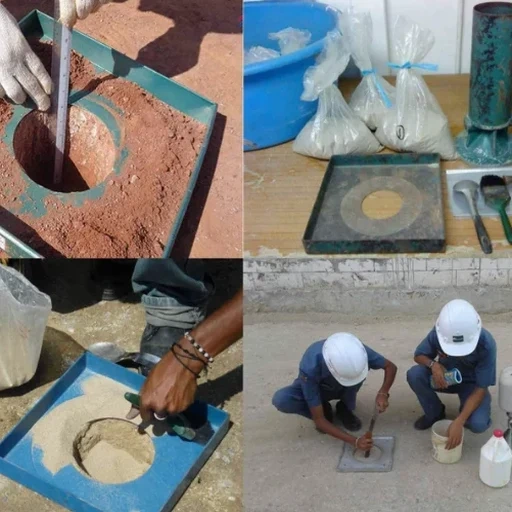
Peoria sits at roughly 600 feet above sea level along the Illinois River, where the local geology shifts from windblown loess on the bluffs to alluvial silts and clays in the river bottom. This variation demands precise compaction control, and that is where the sand cone density test becomes essential. We run field density checks on commercial pads near Pioneer Parkway, residential footings in Dunlap, and roadway subgrades throughout Peoria County. The sand cone method gives us a direct measurement of in-place dry density, which we compare against the Proctor maximum from our lab. Without this verification, even a well-graded base course can settle unevenly under the freeze-thaw cycles that define central Illinois winters. For deeper stratigraphy beneath the fill, we often pair the sand cone with SPT drilling to log native soil strength, and when pavement design requires stiffness input, the CBR test provides the bearing capacity values that IDOT and local municipalities expect.
A 98% Proctor density in Peoria's loess means the difference between a stable slab and a floor that heaves come February.
Local geotechnical context
Peoria's humid continental climate creates a compaction window that opens in April and tightens by late October. Spring rains saturate the silty clay fill common along the riverfront, pushing moisture content well above optimum. If a contractor tries to compact that wet material, the sand cone test will show failing densities no matter how many roller passes they make. We have seen projects near the McClugage Bridge where fill placed in November froze before testing, giving false-high density readings that disappeared after the thaw. The other extreme hits in July and August, when the top inch of a lift dries out in under an hour. Our field techs dig the test hole immediately behind the compactor to capture the true condition. For sites with marginal soils, we recommend a slope stability analysis if the fill supports a surcharge or sits near a cut face, ensuring the compacted mass won't fail along a deeper shear plane.
Quick answers
How much does a sand cone density test cost in Peoria?
A single field density test with the sand cone method in the Peoria area typically runs between US$90 and US$150, depending on the number of tests per mobilization and the travel distance to the site. We can deliver a firm quote once we know the project location and the required testing frequency.
How many sand cone tests do I need for a building pad?
The frequency follows the project specifications, but a common rule is one test per 1,500 to 2,500 square feet per lift. For a typical commercial slab in Peoria, that usually means 4 to 6 tests per lift spread across the pad. We coordinate with the site superintendent to test immediately after compaction, so the crew can keep moving.
Can you run a sand cone test on crushed stone base?
Yes, but we follow the modified procedure for coarse-grained materials. If the maximum particle size exceeds 2 inches, the sand cone method becomes less reliable, and we may recommend a larger test pit or a nuclear gauge with proper calibration. We discuss the material gradation with you before mobilization to bring the right equipment.