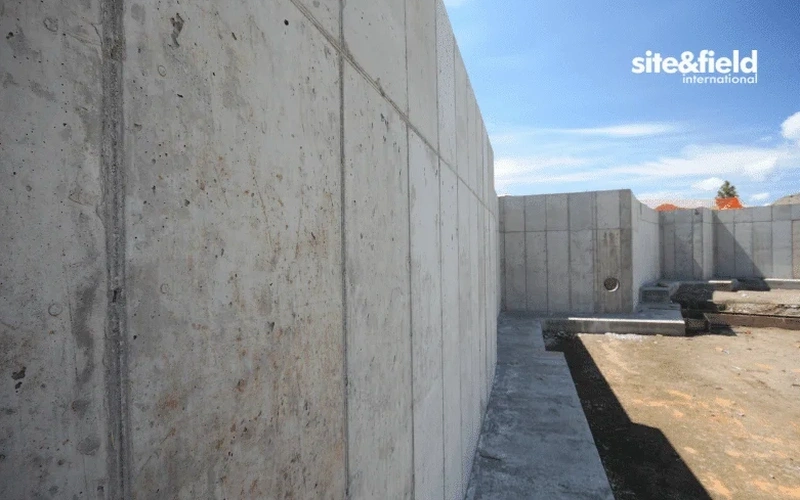
One of the most persistent mistakes we see in Peoria is a retaining wall designed from a textbook without accounting for the local loess. Peoria sits on thick deposits of windblown silt; it stands firm when dry, but loses significant strength when saturated. A generic cantilever wall detail that works fine in gravel will fail here if drainage isn't addressed aggressively. The Illinois River bluffs that shape the west side of Peoria compound the challenge, creating sites where a wall must retain 12 to 18 feet of cut while an adjacent structure sits just 15 feet back from the crest. Before locking in wall dimensions, we typically run a test pit program to sample the loess at full depth and identify any paleosol layers that act as perched water traps. For taller walls along the bluff line, a slope stability analysis becomes non-negotiable once the global geometry involves a slope steeper than 2:1 above or below the wall.
Peoria loess can hold a near-vertical cut for decades until a single wet spring reduces its strength by half; designing the wall for that wet condition is the only safe approach.
Local geotechnical context
Peoria's urban fabric expanded outward from the riverfront in stages, and many older retaining walls built before the 1980s predate modern drainage standards. The Illinois State Geological Survey has mapped extensive loess thicknesses exceeding 20 feet across the bluffs east of the river, and infill development on those slopes now places new walls directly above or below legacy structures. The risk isn't just wall failure: when a poorly drained wall saturates the loess behind it, the zone of influence can extend 1.5 times the wall height upslope, triggering settlement under existing foundations. A liquefaction assessment is rarely required for Peoria's seismic hazard level, but the dynamic response of saturated silt behind a tall wall during a New Madrid-influenced event still merits a pseudostatic check per ASCE 7 §11.8.3. We also evaluate global compound failure surfaces that pass beneath the wall toe, especially where the retained slope continues rising above the top of the wall at angles steeper than 18 degrees.
Relevant standards
IBC 2021 (adopted by City of Peoria) – Chapter 18 Soils and Foundations, ASCE 7-22 – Minimum Design Loads, Sections 3.2 (surcharge) and 11.8 (seismic earth pressure), ASTM D1586 – Standard Penetration Test for soil strength profiling, ASTM D2487 – Unified Soil Classification System (loess = ML), FHWA-NHI-10-024 – GEC No. 2 Earth Retaining Structures (design methodology)
Quick answers
What's the typical cost range for a retaining wall design in Peoria?
For a site-specific retaining wall design in Peoria, including subsurface exploration, geotechnical parameter development, and global stability analysis, the fee generally falls between US$980 and US$4,020. The range depends on wall height, proximity to structures, and whether a slope stability analysis is required. A short gravity wall on a flat residential lot sits at the lower end; a 14-foot cantilever wall near a bluff crest with surcharge from an adjacent building requires the full analysis package and falls at the upper end.
How deep should a retaining wall footing be in Peoria to avoid frost heave?
IBC 2021 requires a minimum footing embedment of 36 inches below finished grade in Peoria County to get below the frost line. For walls retaining more than 6 feet of soil, we often extend the granular drainage blanket 12 inches below the footing base as well, so that any water reaching that depth can escape before freezing.
Can you design a retaining wall on a slope in the Illinois River bluff area?
Yes, and many of our Peoria projects are exactly that. A wall on a slope triggers global stability requirements beyond the standard external checks. We model the entire slope profile, locate the wall within it, and analyze failure surfaces that may pass beneath the wall. The loess on Peoria's bluffs often contains buried soil horizons that act as preferential slip planes, so identifying those layers during the exploration phase is critical.
What lateral earth pressure coefficient do you use for Peoria loess?
We don't use a single number for every job. For compacted granular backfill behind a wall in Peoria, we typically adopt a friction angle of 28 to 34 degrees based on SPT blow counts, which yields an active earth pressure coefficient between 0.28 and 0.35. For the retained loess itself, we run consolidated-drained triaxial tests when the wall height exceeds 12 feet or when a structure sits within the influence zone.