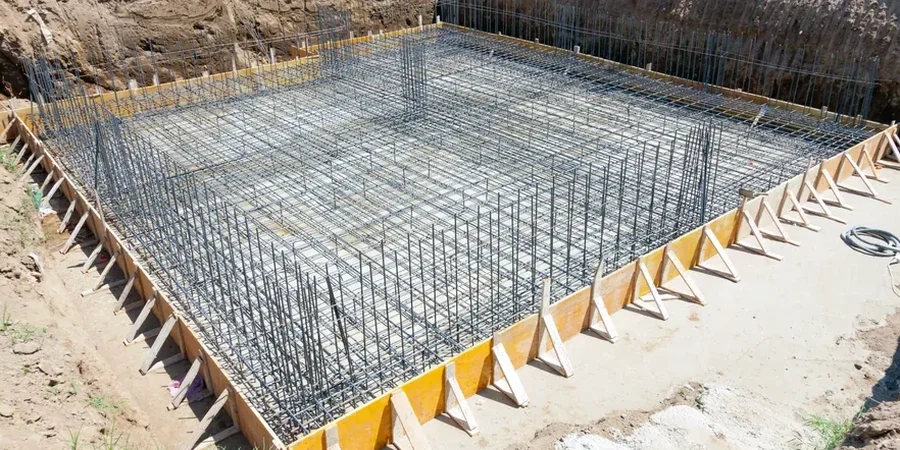
The contrast between Peoria’s historic West Bluff neighborhoods and the flatter East Peoria industrial corridor tells you almost everything you need to know about the local geology. Uphill projects often sit on weathered shale and limestone residuum with pockets of low-strength glacial till, while the Illinois River floodplain deposits can shift from clean sands to compressible silts within a few hundred feet. Designing a raft foundation in Peoria means reconciling these abrupt transitions with a system that distributes structural loads broadly enough to prevent differential settlement, especially where the seasonal water table rises within 3 to 5 feet of finished grade. For complex sites we pair the mat design with a CPT test to map continuous stratigraphy before selecting the bearing stratum. Our team applies IBC 2021 Table 1806.2 presumptive values only after site-specific verification, because the Peoria loess and underlying till rarely behave like textbook uniform soils.
Uniform bearing distribution across Peoria’s variable glacial soils demands a raft design that treats the entire footprint as one interacting system, not isolated strip footings.
Our approach and scope
The humid continental climate of central Illinois puts foundation concrete through roughly 30 to 40 freeze-thaw cycles each winter, a reality that demands careful subgrade preparation beneath any raft system in Peoria County. Air temperatures swing from subzero January lows to July highs above 90°F, and the resulting frost penetration—typically 30 to 36 inches per the local building code—requires extending the mat’s thickened edges below that depth or insulating the perimeter with rigid foam. We specify a minimum 4-inch capillary break of clean, free-draining aggregate atop the compacted subgrade, which interrupts the wicking action that otherwise saturates the slab undersurface during spring thaw. The design also integrates a continuous vapor barrier with taped seams, because the native silty clay soils common around the Dunlap and Chillicothe areas retain moisture aggressively. When the upper soils exhibit plasticity indices above 25, which is frequent in the Peoria loess belt, we model the raft as a semi-rigid plate on an elastic foundation using modulus of subgrade reaction values derived from field plate load testing rather than generic tables.
Local geotechnical context
A mistake we see repeatedly in Peoria County is treating a mat foundation like a slab-on-grade with extra rebar, skipping the geotechnical investigation because ‘the warehouse next door was fine.’ The problem is that the glacial till and outwash deposits in this region were laid down chaotically—you can have stiff, overconsolidated clay at one column line and a lens of loose, saturated silt 20 feet away. Without a site-specific boring program and laboratory consolidation testing, the designer guesses at the modulus of subgrade reaction, and the raft ends up either excessively thick and over-reinforced or dangerously flexible. We have inspected projects near the McClugage Bridge where differential settlement cracked partition walls within two years because the mat was designed for uniform conditions that simply did not exist. The fix costs far more than the initial investigation: mudjacking, additional piles, or full replacement. A proper raft foundation design in Peoria starts with ASTM D1586 borings plus consolidation and swell tests on undisturbed samples, so the structural engineer knows the actual compressibility and expansion potential of the formation that will support the mat.
Quick answers
When is a raft foundation preferable to strip footings in Peoria?
A mat becomes the better choice when the allowable bearing pressure drops below 2,000 psf, which is common in the compressible alluvial silts along the Illinois River corridor, or when the structural loads exceed about 50 percent of the footprint area in column coverage. It also works well where the water table is within 5 feet of the bottom of excavation, because a continuous mat reduces the number of open trenches and simplifies dewatering compared to isolated footings.
How do you handle the expansive potential of Peoria loess under a raft?
We sample the upper 10 to 15 feet of loess and run ASTM D4546 swell-consolidation tests at in-situ moisture and density. If the expansion index exceeds 20, we typically recommend a moisture-conditioned fill layer with a minimum 12-inch thickness beneath the mat, combined with a perimeter drain and positive drainage away from the building. The raft’s stiffness helps suppress differential heave, but the subgrade treatment is the primary defense.
What does a raft foundation design cost for a Peoria project?
For a typical commercial or light-industrial building in Peoria, the geotechnical investigation plus the foundation parameter report generally falls between US$1,100 and US$3,990, depending on the number of borings, laboratory tests required, and whether CPT soundings supplement the SPT data. A site with highly variable conditions or deeper compressible layers will be at the upper end due to the additional sampling and consolidation testing needed.
Do Peoria building officials require a special review for mat foundations?
The City of Peoria Community Development Department reviews mat foundation designs under IBC 2021 Chapter 18, and they will ask for the geotechnical report with bearing capacity and settlement calculations signed by an Illinois-licensed engineer. If the raft supports a structure in Seismic Design Category C or D—which applies to essential facilities and taller buildings in Peoria County—the lateral resistance system must also be justified, including base shear transfer through the mat.