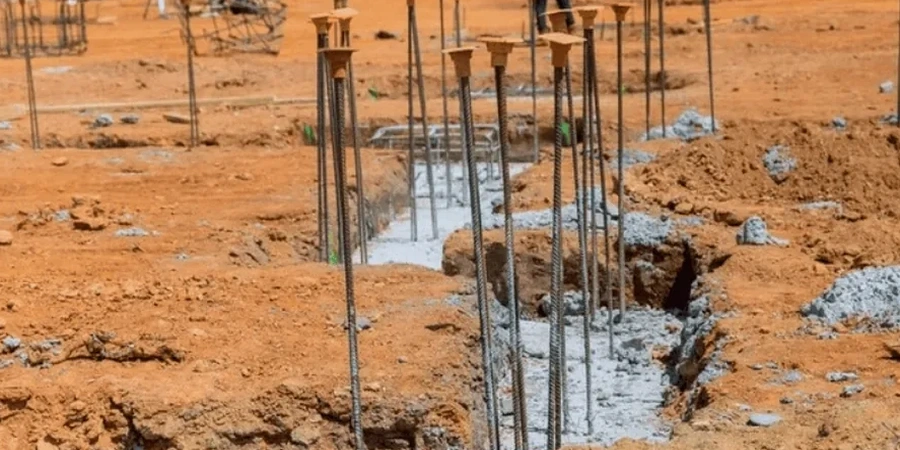
A mid-rise expansion near the Peoria riverfront hit refusal on glacial till at 28 feet, but the upper 15 feet were loose, saturated silts left by the ancient Illinois River channel. That job needed a pile foundation design that could transfer structural loads past the erratic fill and into competent material without excessive settlement. Across Peoria, the subsurface conditions shift dramatically between the bluffs, the bottomlands, and the reclaimed industrial parcels along SW Washington Street, which means the foundation solution for a medical office in the East Bluff is rarely the same as for a warehouse in Pioneer Park. We approach every project by first reconciling the geotechnical data with the structural demand, then selecting the pile type and installation method that makes sense for the site. The test pits investigation provides the initial soil profile, and we pair that with SPT drilling to quantify blow count variability across the depth of interest before any design parameter is locked in.
Peoria's glacial and alluvial soil sequence demands pile designs that are validated against site-specific load tests, not just textbook correlations.
Our approach and scope
In Peoria, the loess-covered bluffs behave very differently from the alluvial deposits near the river, and a pile design that ignores those contrasts can lead to costly overruns or underperformance. We define the axial capacity using static analysis calibrated against local load test databases, and we model lateral response under the wind and seismic loads prescribed by ASCE 7 for this part of the Midwest. For projects where the upper soils are too soft to mobilize meaningful skin friction, we often combine the deep foundation with a ground improvement approach using stone columns to stabilize the upper zone before piling begins. We specify driven H-piles, pipe piles, or augered cast-in-place piles depending on the depth to bedrock, the groundwater table, and the allowable vibration thresholds near existing structures. Every pile foundation design package we deliver for Peoria includes a settlement estimate, a pile-cap geometry recommendation, and a quality-control testing protocol that aligns with the IBC requirements for special inspection.
Local geotechnical context
The Illinois River basin left behind sequences of soft clay, loose sand, and organic silt layers that can introduce negative skin friction if the surrounding grade settles after construction. In the downtown Peoria area, where older structures sit on shallow footings, pile driving vibrations must be monitored and controlled to avoid damage claims, and the design should specify pre-drilling or low-displacement piles when the clearance is tight. A deeper risk is the presence of abandoned coal-mine workings south and east of the city center; if a boring encounters a void or collapsed material, the pile foundation design must immediately shift to a socketed solution that bridges the compromised zone. Ignoring the groundwater fluctuation in the Illinois River floodplain can also reduce the effective stress and the calculated end-bearing capacity, which is why we always run sensitivity analyses that bracket the seasonal water table.
Quick answers
What is the typical cost range for a pile foundation design in Peoria?
For a standard commercial or mid-rise project in the Peoria area, the engineering fee for a pile foundation design package, including the geotechnical interpretation, axial and lateral analysis, and the construction specification, typically falls between US$1,470 and US$7,220. The final number depends on the number of pile types evaluated, the complexity of the soil profile, and whether high-strain dynamic testing is included in the scope.
How deep do piles usually need to go in Peoria's soil conditions?
Depth varies sharply across the city. In the river bottomlands, piles often extend 45 to 70 feet to reach dense glacial till or bedrock, while on the bluffs east of downtown, competent limestone can appear at less than 25 feet. We determine the required tip elevation through borings that extend at least 10 feet into the bearing stratum, following ASTM D1586 sampling procedures.
Do you perform pile load testing as part of the design process?
Yes, we include a testing protocol in every design package. For most Peoria projects, we specify high-strain dynamic testing according to ASTM D4945 during initial driving and restrike, which verifies that the field capacity matches the design assumptions. When the structure is particularly sensitive to settlement, we may also recommend a static load test on a sacrificial pile.
Can you design pile foundations for projects near existing buildings in downtown Peoria?
Absolutely. When the site is adjacent to historic masonry structures or occupied buildings, we select low-vibration pile types such as augered cast-in-place or micropiles, and we set vibration monitoring thresholds based on the existing structure's condition. The design also includes a pre-construction survey and a vibration control plan that satisfies the City of Peoria building permit requirements.